The currency symbol for Indian rupee is RS. Denominations have past RS are those - The Indian currency is called the Indian Rupee, and the coins are called the paise. One Indian Rupee is made up of 100 paise. Paper money comes in allotments of Rs.5, Rs.10, Rs.20, Rs.50, Rs.100, Rs.500 and Rs.1000. Coins come in allotments of 10 paise, 20 paise, 25 paise, 50 paise, one rupee, two rupees and five rupees. According to the Reserve Bank of India Act (1934), coins can be issued up to Rs. 1000, and bank notes can be issued in denominations of Rs. 1000, Rs. 5000, Rs. 10000, or any other value that the Central Government may specify.
History of the Rupee is following - India was one of the first issuers of coins (circa: 6th Century BC), and as a result it has seen a wide range of monetary units throughout its history. There is some historical evidence to show that the first coins may have been introduced somewhere between 2500 and 1750 BC. However, the first documented coins date from between the 7th/6th century BC to the 1st century AD. These coins are called 'punch-marked' coins because of their manufacturing technique.
Over the next few centuries, as traditions developed and empires rose and fell, the country's coinage designs reflected its progression and often depicted dynasties, socio-political events, deities, and nature. This included dynastic coins, representing Greek Gods of the Indo-Greek period followed by the Western Kshatrapa copper coins from between the 1st and the 4th Century AD.
In 712 AD, the Arabs conquered the Indian province of Sindh and brought their influence and coverage with them. By the 12th Century, Turkish Sultans of Delhi replaced the longstanding Arab designs and replaced them with Islamic calligraphy. This currency was referred to as 'Tanka' and the lower valued coins, 'Jittals'. The Delhi Sultanate attempted to standardise this monetary system and coins were subsequently made in gold, silver and copper.
In 1526, the Mughal period commenced, bringing forth a unified and consolidated monetary system for the entire Empire. This was heavily influenced by the Afghan Sher Shah Suri (1540 to 1545) who introduced the silver Rupayya or Rupee coin. The princely states of pre-colonial India minted their own coins, all which mainly resembled the silver Rupee, but held regional distinctions depending on where they were from. During the late 18th Century when political unrest occurred, agency houses developed banks such as the Bank of Bengal and Bahar, The Bank of Hindustan, Orient Bank Corporation and The Bank of Western India. These banks also printed their own paper currency in the Urdu, Bengali and Nagri languages.
It was only in 1858 when the British Crown gained control of the one hundred Princely states, and subsequently ended the Mughal Empire, that the coin's native images were replaced by portraits of the Monarch of Great Britain to indicate British Supremacy. In 1866, when the financial establishments collapsed, the control of paper money also shifted to the British Government. This was subsequently passed to the Mint Masters, the Accountant Generals and the Controller of Currency. In 1867, the Victoria Portrait series of bank notes was issued in honour of Queen Victoria.
After gaining its independence in 1947 and becoming a republic in 1950, India's modern Rupee reverted back to the design of the signature Rupee coin. The symbol chosen for the paper currency was the Lion Capital at Sarnath which replaced the George VI series of bank notes. In 1996, the Mahatma Gandhi Series of Paper notes was introduced.
Rabu, 29 September 2010
Indian Rupee

Selasa, 28 September 2010
Private Number Plates
Private Number Plates
Rabu, 25 November 2009
The history of currency or history of money

History of currency is a wide concept. In all the history of the world currency evolution is marked with lots of changes. First of all we were trading with commodity money. Many cultures around the world eventually developed the use of commodity money. Ancient
After commodity money we were passing through standardized coinage. Coinage was widely adopted across Ionia and mainland  A major silver vein discovery at Laurium in 483 BC led to the huge expansion of the Athenian military fleet. Competing coinage standards at the time were maintained by Mytilene and Phokaia using coins of Electrum;
Right next standardized coinage are coming representative money. Representative money refers to money that consists of a token or certificate made of paper (legal tender). The use of the various types of money including representative money, tracks the course of money from the past to the present.

Token money may be called “representative money” in the sense that, say, a piece of paper might 'represent' or be a claim on a commodity also. Gold certificates or Silver certificates are a type of representative money which were used in the
Fiat money are next in historical plan. Fiat money refers to money that is not backed by reserves of another commodity. The money itself is given value by government fiat (Latin for "let it be done") or decree, enforcing legal tender laws, previously known as "forced tender", whereby debtors are legally relieved of the debt if they (offer to) pay it off in the government's money.  By law the refusal of "legal tender" money in favor of some other form of payment is illegal, and has at times in history (
Governments through history have often switched to forms of fiat money in times of need such as war, sometimes by suspending the service they provided of exchanging their money for gold, and other times by simply printing the money that they needed. When governments produce money more rapidly than economic growth, the money supply overtakes economic value. Therefore, the excess money eventually dilutes the market value of all money issued. This is called inflation.
These days no one can live without credit money. Credit money often exists in conjunction with other money such as fiat money or commodity money, and from the user's point of view is indistinguishable from it. Most of the western world's money is credit money derived from national fiat money currencies.
In a modern economy, a bank will lend to borrowers in excess of the reserve it carries at any time, this is known as fractional reserve banking. In doing so, it increases the total money supply above that of the total amount of the fiat money in existence (also known as M0). While a bank will not have access to sufficient cash (fiat money) to meet all the obligations it has to depositors if they wish to withdraw the balance of their cheque accounts (credit money), the majority of transactions will occur using the credit money (cheques and electronic transfers).
Senin, 23 November 2009
Swiss Franc History
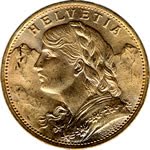
The Swiss Franc is the national currency for both Switzerland and Liechtenstein. The much smaller Principality of Liechtenstein does however retain the ability to mint its own currency, the Liechtenstein Frank, which it does occasionally for commemorative or emergency purposes.
The Swiss Franc is known as a 'hard currency'. The franc holds this reputation as, until May 2000 fiscal laws required a 40 per cent gold cover for currency in circulation. This enabled the currency to remain very stable, thus making Swiss banks more attractive to international investors.
In the first half of the nineteenth century, the Swiss franc was unregulated and as such was considered to be a highly variable and complicated currency. Before the currency was regulated in 1850 by the Swiss Federal Constitution, the country had 75 entities and 25 cantons - all of which produced their own individual coins. The situation was further complicated by private banks distributing their own banknotes, thus adding to the lack of uniformity amongst the currency.
The introduction of the Swiss Federal Constitution of 1848 and the Federal Coinage Act of 1850 ensured that only the Federal government could distribute currency and that the Franc became the nationally recognised currency.

It would not be until 1907 when the first Swiss banknotes would be printed. Since then, eight different series of banknotes have been distributed. The notes differ in size, colour and design so as to distinguish the value of the notes. The banknotes also feature the four national languages of Switzerland: German, Romansh, French, and Italian.
History of Danish Krona

The currency system in Denmark came into existence in 1625 when rigsdaler was made the official currency of the country. It had 3 subunits to it namely mark, skilling and pfennig with a complex exchange among them i.e. 1 rigsdaler = 6 mark, 1 mark = 16 skilling, 1 skilling = 12 pfennig. This complex rate regime continued over a long period of time with some small corrections in the mean while. In 1873, Scandinavian Monetary Union was established constituting of two countries i.e. Sweden and Denmark.
The purpose of this union was to revalue the currencies of the member countries to put them at par with each other and fixing them against gold. It was due to this monetary union that krone was introduced in Denmark and became the legal tender in the country. The currency got onto the gold standard with a fixed exchange rate of 2480 kroner = 1 kilogram of fine quality gold. During the First World War, the gold rate of all the currencies was abandoned and krone too, was affected by it. The Scandinavian Monetary Union was dissolved and krone was brought down but it was decided that the name of their now separate currencies wont be changed. Denmark once again fixed its currency to the gold standard in 1924 but it had quit it permanently in 1931. Krone was pegged to the German reichsmark during the German occupation from the year 1940 to 1945 but after the Second World War was over it was pegged to the British pound and US dollar. When in 1999, the European common currency, euro was launched, most of the European countries opted in favor of the currency but Denmark moved out of the Maastricht treaty so that it could protect its own currency.
Swedish Krona history

Sweden was using riksdaler as its currency till 1873 when the currently prevailing currency that is the Swedish krone replaced it. The riksdaler served as the country’s national currency for a long time as it was being used since 17th century.
The name riksdaler was taken from the German word "thaler", from which the names of other European currencies were also taken such as "Reichstaler" (German currency), "Rijksdaalder" (currency of Austria-Hungary) and "Rigsdaler" (currency of Denmark-Norway). This old currency had a complex subunit division system consisting of mark, öre, penning and later on skillingar and runstycken. In 1885, the Swedish currency adopted the decimal system with the introduction of a new version of the currency that was the "riksdaler riksmynt". Swedish krona came into existence when the country agreed to join the Scandinavian Monetary Union, the other members being Denmark and Norway. These three countries fixed the value of their respective currencies against gold to gain monetary stability. This union lasted until the World War I resulting the countries to lose their pegs to gold. Sweden held on to the same currency and same name of the currency even after the monetary union was discarded. The same currency is in operation till date even though the other two currencies of the union have switched over to the euro in recent times.
Currency History
Historically, money in the form of currency has predominated. Usually (gold or silver) coins of intrinsic value commensurate with the monetary unit (commodity money), have been the norm. By contrast, modern currency, as fiat money, is intrinsically worthless. The prevalence of one type of currency over another in commodity money systems has arisen, usually when a government designates through decrees, that only particular monetary units shall be accepted in payment for taxes.